

From the smartphone in your pocket to satellites orbiting Earth, antennas are everywhere – even if you rarely see them. They quietly power our ability to communicate, navigate, monitor, and automate across nearly every aspect of life. In this post, we’ll take a closer look at how antennas are used in different fields, from healthcare and agriculture to aerospace and defence, and why they’re such a vital part of today’s wireless world.

Communication Systems
The most well-known and widespread application of antennas is in communication systems. For over a century, antennas have been used to transmit and receive information over radio waves.
In radio and television broadcasting, large antennas mounted on towers transmit high-power signals to wide geographic areas. These signals are picked up by antennas in radios and TV sets, enabling mass communication over vast distances. Although the medium has evolved, antennas remain essential in broadcasting technologies, especially in rural or underserved regions.
Mobile and cellular networks rely heavily on antennas both at infrastructure level – like base stations – and in end-user devices such as smartphones. Cell towers are equipped with directional or omnidirectional antennas designed to cover specific sectors. Meanwhile, mobile devices include multiple miniature antennas to handle 4G, 5G, Wi-Fi, GPS, and Bluetooth simultaneously.
Wi-Fi routers, Bluetooth-enabled devices, and satellite communication systems all depend on antennas tailored for their specific frequency bands and performance needs. Whether it’s streaming a video on a tablet or receiving signals from a geostationary satellite, antennas form the physical bridge between hardware and the electromagnetic spectrum.
Key technologies that rely on antennas in communication systems:
- AM/FM radio and TV broadcasting
- Cellular networks (3G, 4G, 5G)
- Wi-Fi and Bluetooth
- Satellite communication and GPS
The Internet of Things (IoT)
As the Internet of Things continues to grow, billions of devices are being connected – each one requiring reliable, low-power wireless communication. Antennas make this possible by enabling efficient signal transmission even in compact, battery-operated designs.
In smart homes, antennas in devices like thermostats, security cameras, and smart plugs connect everything wirelessly, using protocols like Zigbee, Z-Wave, or Wi-Fi. At a larger scale, smart cities deploy antennas in infrastructure for street lighting control, traffic monitoring, and environmental sensing.
Wearable devices such as fitness trackers and health monitors also integrate antennas to send data to smartphones or the cloud. These antennas must be ultra-compact and energy-efficient to suit wearable form factors.
Industrial IoT (IIoT) uses antennas in rugged environments, allowing factories to wirelessly monitor machines, automate production lines, and predict maintenance needs. Similarly, antennas are key in agriculture for monitoring soil and weather conditions, and in environmental science for tracking air and water quality.
Asset tracking systems and utility meters use RFID or LPWAN antennas to provide real-time data about location, usage, and operational status. In transportation, antennas are critical to connected vehicle technologies, including Vehicle-to-Everything (V2X) communication, which supports autonomous driving and intelligent traffic systems.
IoT applications that depend on antennas include:
- Smart home and city infrastructure
- Wearables and personal health monitoring
- Industrial sensors and automation
- Agriculture and environmental monitoring
- Asset tracking and smart metering
- Connected vehicles and transportation systems
Automotive
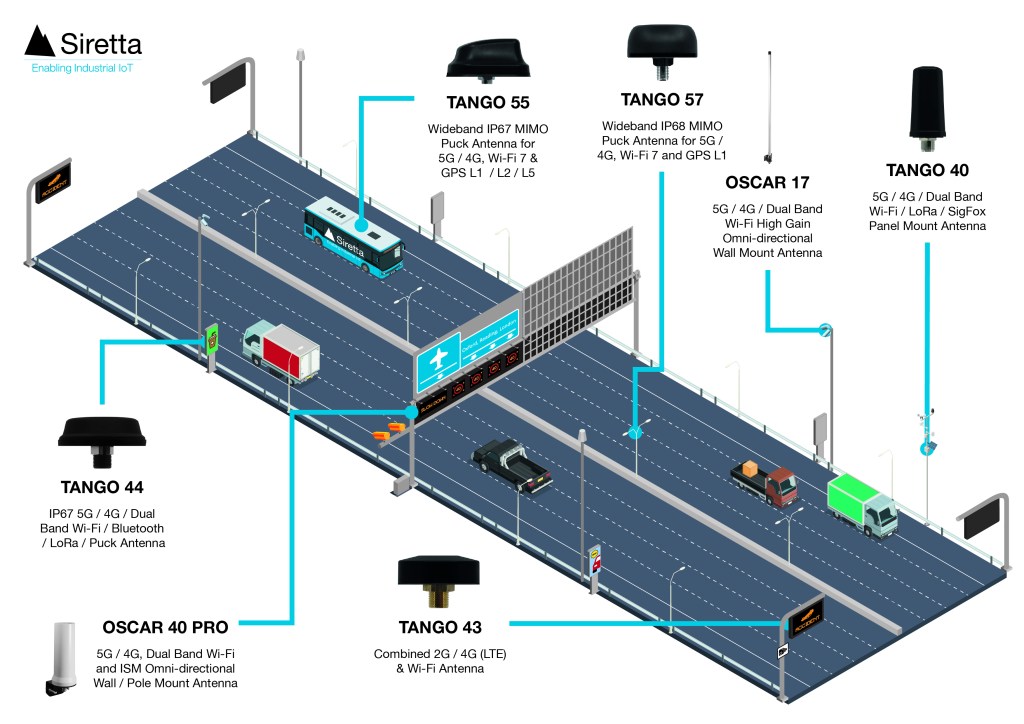
Modern vehicles are equipped with a wide range of wireless features that rely on antennas. From navigation to infotainment and advanced driver-assistance systems, antennas play a role in the connected car ecosystem.
GPS navigation is one of the most common uses. GPS antennas receive signals from satellites, allowing drivers to navigate routes, get traffic updates, and enable location-based services. Many vehicles also include antennas for cellular connectivity, enabling real-time diagnostics, remote access, emergency calls, and internet access through telematics systems.
Remote keyless entry systems use short-range antennas in both the key fob and vehicle to allow seamless access without inserting a key. As electric and autonomous vehicles become more common, antennas are also used for V2X communication, vehicle diagnostics, and over-the-air software updates.
In vehicles, antennas are used for:
- GPS navigation and tracking
- Telematics and cellular connectivity
- Remote keyless entry
- Vehicle-to-Everything (V2X) communication
Aerospace and Space
Antenna systems are crucial in the aerospace sector, where communication over long distances and in extreme environments is a necessity. In satellite communication, parabolic and phased array antennas handle high-bandwidth data transfer between orbiting satellites and Earth-based ground stations. These antennas support GPS, internet services, Earth observation, and military operations.
Deep space communication systems, like NASA’s Deep Space Network, rely on extremely large and sensitive antennas to send and receive signals from spacecraft millions of kilometres away. These systems enable telemetry, tracking, and command for missions exploring the outer solar system and beyond.
Drones and unmanned aerial vehicles (UAVs) also use antennas for control, video streaming, and telemetry. Depending on the drone’s range and use case, antennas may be omnidirectional for general coverage or directional for long-range communication.
Examples of aerospace antenna applications:
- Satellite communication and navigation
- Deep space telemetry and data transfer
- UAV control and data streaming
Defence and Military
Military systems require robust, secure, and often stealthy antenna designs. Radar systems use antennas to detect aircraft, ships, and ground targets. These systems emit pulses and analyse their reflections to determine the position, speed, and size of objects.
Missile guidance systems incorporate antennas for receiving real-time corrections and targeting data. In electronic warfare, antennas are used to jam or intercept enemy signals, providing both offensive and defensive capabilities.
Military communication systems – ranging from portable radios to satellite terminals – require antennas that can function reliably in harsh conditions and across multiple frequencies.
Military and defence applications include:
- Radar and surveillance systems
- Guided missile communication
- Electronic warfare and jamming
- Tactical communications and secure radio links
Medical
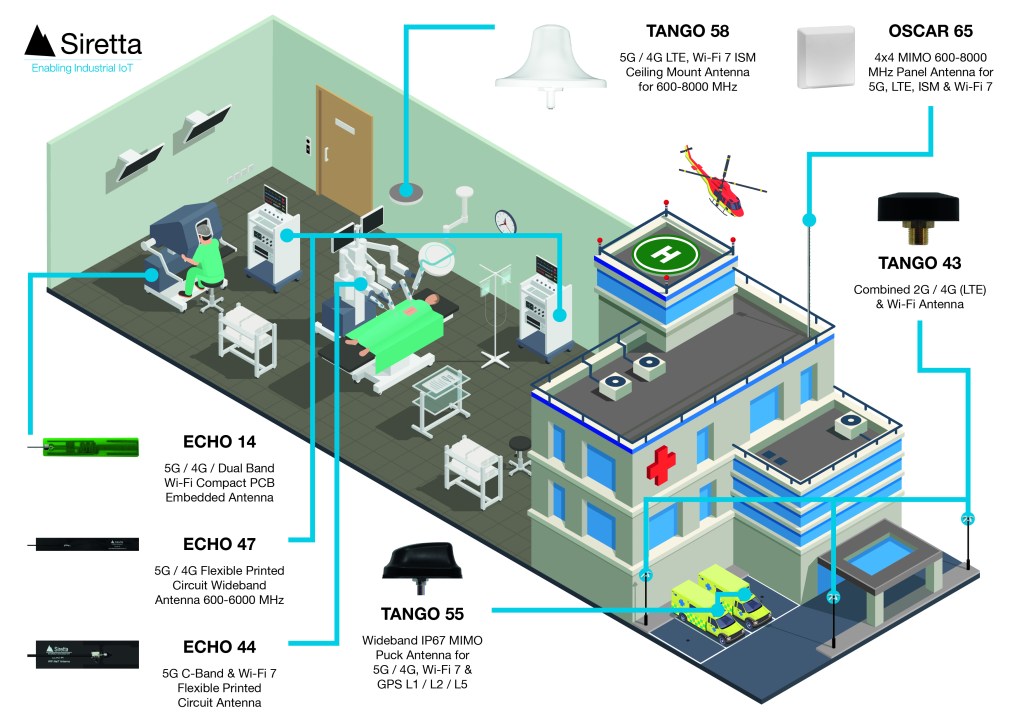
Antennas in the medical field enable a new era of non-invasive diagnostics, monitoring, and treatment. Implantable devices like pacemakers and insulin pumps use antennas to communicate vital information to external readers, allowing remote monitoring and adjustment without surgery.
Wearable medical devices such as ECG patches or glucose monitors continuously collect health data and send it wirelessly to healthcare providers. These systems improve early detection and patient outcomes.
Hospitals also use antennas for equipment tracking and patient movement monitoring, ensuring efficient workflow and reducing errors in critical environments.
Medical technologies using antennas include:
- Implantable medical devices
- Remote patient monitoring wearables
- Hospital equipment and asset tracking
Industrial and Commercial
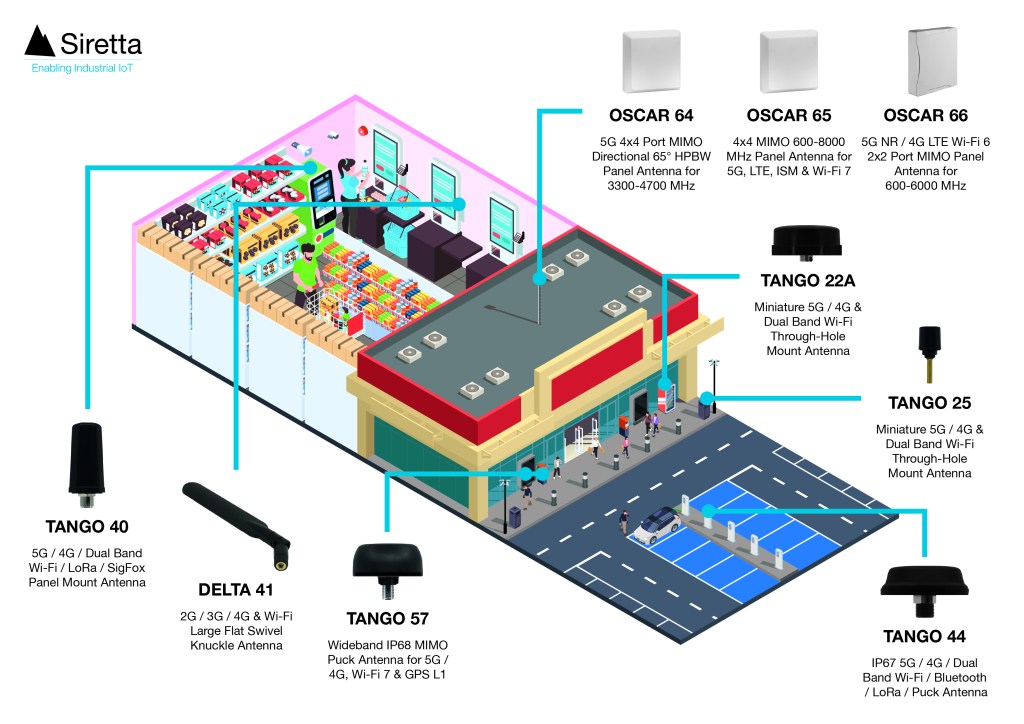
In industrial settings, antennas play a pivotal role in enabling automation, efficiency, and safety. Radio-frequency identification (RFID) systems use antennas in readers and tags for inventory control, access management, and supply chain visibility.
Wireless sensors equipped with antennas allow real-time monitoring of temperature, pressure, and machinery conditions. These sensors support predictive maintenance strategies that minimise downtime and reduce operational costs.
In commercial environments like retail and logistics, antennas facilitate smart shelving, loss prevention, and dynamic pricing systems.
Common industrial/commercial uses of antennas:
- RFID-based inventory and access control
- Wireless sensors for monitoring and automation
- Asset tracking and logistics optimisation
Consumer Electronics
In the consumer space, antennas are everywhere – from the obvious to the invisible. Smartphones, tablets, and laptops contain multiple antennas for cellular, Wi-Fi, Bluetooth, GPS, and NFC. Each must be optimised for size, efficiency, and coexistence in a compact form factor.
Wireless audio products like earbuds and headphones include Bluetooth antennas for stable audio transmission and low-latency performance. Smartwatches and other wearables incorporate antennas into small form factors without compromising comfort or performance.
Smart home devices such as voice assistants, light bulbs, doorbells, and smart thermostats rely on antennas to connect with hubs or cloud services, enabling automation and remote control.
Antennas are embedded in:
- Smartphones, laptops, and tablets
- Wireless audio and wearable devices
- Smart home and voice-controlled systems
Scientific Research
In scientific fields, antennas enable discoveries both above and below the Earth’s surface. Radio astronomy uses large antennas to detect faint signals from distant celestial objects. These observations help scientists study cosmic phenomena like black holes, pulsars, and the cosmic microwave background.
Remote sensing systems on aircraft or satellites use antennas to map terrain, analyse vegetation health, and monitor environmental conditions. Ground-penetrating radar (GPR) employs antennas to detect structures and objects buried underground – useful in archaeology, geology, and civil engineering.
Examples of scientific applications:
- Radio telescopes and astrophysical observations
- Remote sensing for Earth observation
- Ground-penetrating radar and subsurface imaging
Understanding Antenna Applications
From industrial automation to aerospace telemetry, antenna applications span an impressive range of use cases, each with its own technical demands and constraints. The diversity of applications highlights the importance of understanding antenna behaviour under real-world conditions.

How to Select the Right Antenna for Your Application


How Environmental Considerations Affect Antenna Selection

A Guide to Impedance Matching

Antenna Types Explained: Mounting Styles and Applications

Understanding Key Antenna Parameters


Understanding Antenna Radiation Patterns

Exploring IoT in Digital Twins & Building Information Modelling (BIM)

Waste and Fuel Management in Construction with IoT

Predictive Maintenance and Remote Machine Management in Construction Using IoT

Tool & Equipment Tracking in Construction Using IoT