

When it comes to antennas, performance is defined by several key parameters. These characteristics determine how well an antenna transmits and receives signals, affecting everything from range and signal quality to efficiency and suitability for specific applications.
In this article, we’ll explain the essential antenna parameters you must know: gain, directivity, efficiency, bandwidth, and polarisation. By understanding these terms, you’ll be better equipped to select or design antennas that meet your project’s needs.
What is Antenna Gain and Why Does it Matter?
Antenna gain is one of the most commonly referenced specifications. It describes how effectively an antenna radiates or receives energy in a particular direction, compared to a reference antenna such as an isotropic radiator, which radiates equally in all directions. Gain reflects both the antenna’s ability to focus energy in a specific direction (directivity) and its efficiency in converting input power into radiated power.
Gain is measured in decibels, either relative to an isotropic antenna (dBi) or a dipole antenna (dBd). A higher gain value generally indicates stronger signal strength in the desired direction, but with reduced coverage in others.
When choosing antenna gain, the trade-off between coverage and range must be considered:
- High-gain antennas provide strong signals in a narrow beam, ideal for long distance and point-to-point communication
- Low-gain antennas offer broad coverage, making then suitable for short-range or omnidirectional applications
What is Antenna Directivity? (And How it Differs from Gain)
Directivity measures how concentrated an antenna’s radiation pattern is in its strongest direction, without considering losses. It represents the antenna’s ability to focus energy and is a purely geometric property derived from the antenna’s radiation patten.

Like gain, directivity is expressed in decibels (dBi), but unlike gain, it does not account for efficiency. In simple terms, it shows how much more power is radiated in the main direction compared to an ideal isotropic source.
The relationship between directivity and gain is fundamental:
- Gain combines directivity with efficiency.
- Directivity tells you how focused the energy is; gain tells you the actual radiated power in that direction.
Antenna Efficiency Explained: Radiation Efficiency vs Total Efficiency
Efficiency plays a crucial role in antenna performance, measuring the proportion of input power that is successfully radiated as electromagnetic waves. Any power that is lost internally, due to heating or material absorption, reduces efficiency.
There are two types of efficiency:
- Radiation efficiency considers only the losses due to the antenna’s construction materials, such as conductor resistance and dielectric absorption.
- Total efficiency also includes impedance mismatch losses that occur when the antenna is not well-matched to the transmission line or source.
Several factors can reduce antenna efficiency:
- Conduction losses in the antenna’s metal parts.
- Dielectric losses in surrounding materials.
- Impedance mismatch between the antenna and the feedline, which causes power to be reflected instead of radiated.
Efficiency is often measured indirectly by analysing how much power is delivered versus radiated, and it directly affects antenna gain:
- Even if an antenna has high directivity, poor efficiency will lower its overall gain.
Most antennas also follow the principle of reciprocity, meaning their performance in transmitting and receiving is the same under identical conditions, including efficiency.
What is Antenna Bandwidth?
Bandwidth refers to the range of frequencies over which the antenna operates effectively. This parameter is crucial in systems where signal frequencies vary or where wide frequency coverage is required.
An antenna naturally resonates at certain frequencies, but bandwidth defines the range within which the antenna maintains good performance. This includes factors such as acceptable impedance matching, stable gain, and consistent radiation patterns.
Antenna bandwidth is typically assessed by measuring:
- Voltage Standing Wave Ratio (VSWR), with a common threshold of 2:1 for acceptable performance.
- Return loss, often with a benchmark of -10 dB or better.
- Stability of gain and radiation pattern across the frequency range.
Bandwidth can be expressed either as an absolute value (in hertz) or as a percentage of the centre frequency:
- Absolute bandwidth is simply the difference between the upper and lower frequencies.
- Percentage bandwidth offers a relative view, showing how broad the frequency range is in comparison to the centre frequency.
Different applications require different bandwidths:
- Narrowband antennas are efficient and stable but limited to specific frequencies, ideal for systems like GPS.
- Wideband antennas cover broad frequency ranges and are suited for broadband, multi-band, or agile communication systems.
+
Antenna Polarisation Explained: Linear, Circular, and Elliptical
Polarisation refers to the orientation of the electric field in the electromagnetic wave radiated by the antenna. It is a vital factor in ensuring effective signal transmission and reception.
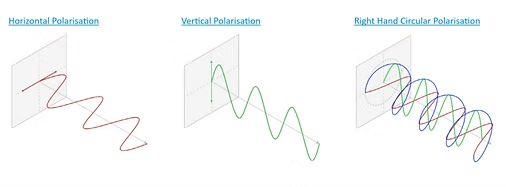
There are several types of polarisation:
- Linear polarisation, where the electric field oscillates in a single plane, which can be vertical, horizontal, or slanted at an angle.
- Circular polarisation, where the electric field rotates in a circular pattern as the wave propagates. It can be right-hand circular (RHCP) or left-hand circular (LHCP).
- Elliptical polarisation, which is a hybrid between linear and circular, with the electric field tracing an elliptical path.
Due to antenna reciprocity, polarisation remains the same for both transmission and reception under the same conditions.
Correct polarisation alignment is critical because mismatches lead to significant signal loss:
- Matched polarisation ensures maximum signal transfer.
- A mismatch between linear and circular polarisation generally results in a loss of about 3 dB.
- Orthogonal polarisations (such as vertical versus horizontal) can cause severe or even complete signal loss in ideal conditions.
Mounting and physical orientation also influence polarisation. Rotating or tilting an antenna can change its polarisation type or shift the polarisation angle.
Choosing the correct polarisation depends on the intended use:
- Fixed links benefit from aligned linear polarisation for maximum efficiency.
- Mobile and portable systems often use circular or slant polarisation to handle device movement and signal reflections.
- Satellite communications frequently employ circular polarisation to mitigate signal degradation caused by atmospheric conditions and motion.
Optimising Antenna Performance
These five key antenna parameters – gain, directivity, efficiency, bandwidth, and polarization – are essential in understanding and optimising antenna performance. They are often interconnected; improving one parameter can impact others. The goal is to carefully balance these characteristics according to the specific needs of your system, whether it’s a long-range directional link, an omnidirectional coverage area, or a wideband application.

How to Select the Right Antenna for Your Application


How Environmental Considerations Affect Antenna Selection

Antenna Applications

A Guide to Impedance Matching

Antenna Types Explained: Mounting Styles and Applications
Understanding Antenna Radiation Patterns


Exploring IoT in Digital Twins & Building Information Modelling (BIM)

Waste and Fuel Management in Construction with IoT

Predictive Maintenance and Remote Machine Management in Construction Using IoT

Tool & Equipment Tracking in Construction Using IoT